


A voice guide answers the question every writer asks first
A brand voice guide is a short document that describes how your site sounds in writing: who you are writing for, the kind of language you use, and what you will and won't say. It answers a question that comes up each time someone sits down to write for you, whether that is you on a Sunday evening, a freelancer or an AI tool: what should this sound like?
Most guides start from a simple split. Your message is what you say; voice and tone are how you say it, as Texas A&M's guide frames it. Sheffield Hallam University puts it in almost the same words: tone of voice is how something is said rather than what is said, the language used and the personality shown through it.
For a WordPress site that publishes regularly, the reason to write this down is practical. One article a month written by the owner tends to sound like the owner. Twenty articles over a year, some written in a hurry and some by someone else, can drift apart. A guide gives you something more specific to check a draft against than a feeling that it is a bit off. The examples below come mostly from university brand guides, which publish theirs openly and have to keep many writers consistent. The questions they answer are the same ones a small site faces, just at a different scale.
Voice stays put; tone moves with the occasion
Guides usually divide the "how" into two layers. Voice is the part that does not change. Texas State University describes its voice as its unchanging core personality and treats tone as a changeable mood rooted in that voice. The University of Arizona's guide calls voice the constant that should stay recognisable whatever the audience or channel.
Tone is the part that adjusts. The University of Guelph gives a clear example: a social media post reminding alumni about a reunion will not sound like a printed annual donor report. The University of Arkansas's guide says its brand personality belongs in all messaging, while the tone can be more flexible.
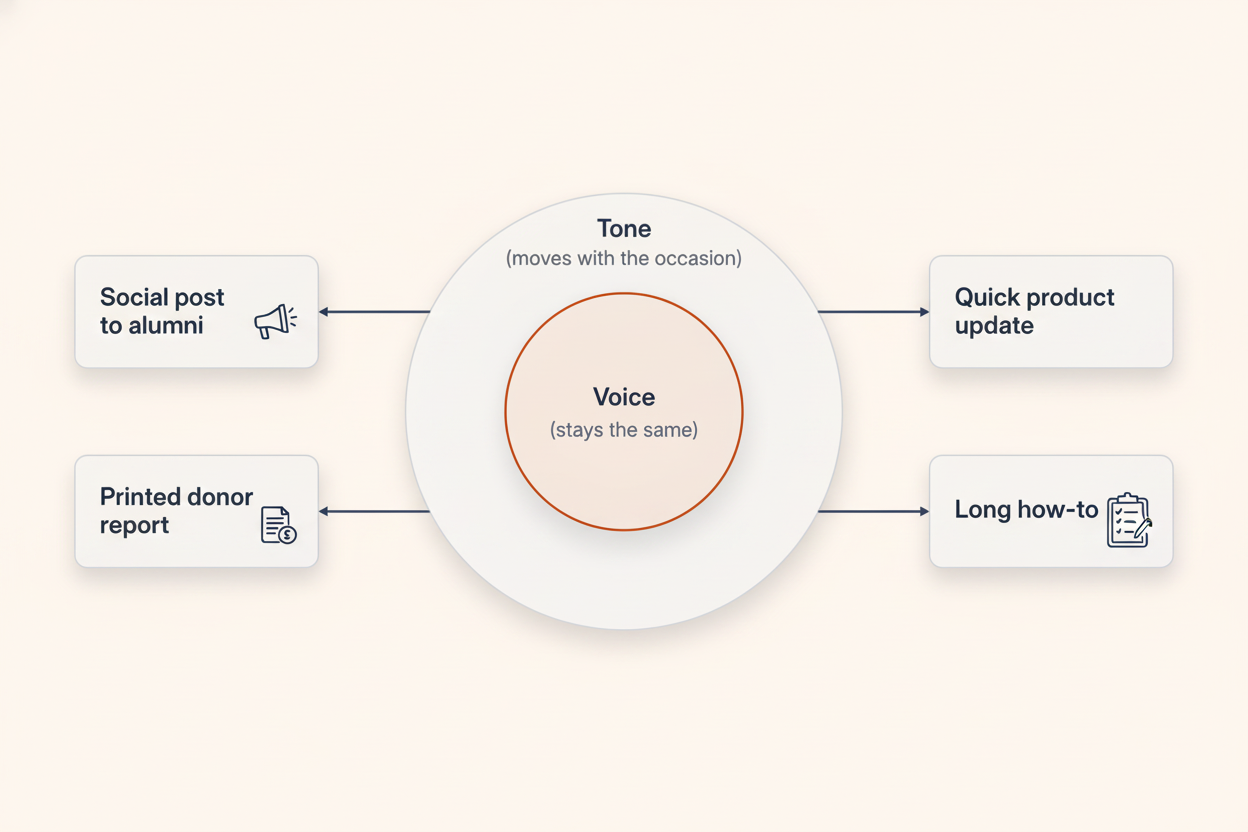
Not every guide draws the line in the same place. The University of Manchester's guide takes the opposite emphasis: different audiences expect different messages, it says, but they don't expect a different tone of voice for each one. For a small site this disagreement is useful, because it marks a decision you have to make yourself. If your articles range from a quick product update to a long how-to, decide whether the tone loosens for the short pieces or stays the same everywhere, and write that decision into the guide.
Arizona adds a point that saves a lot of forced writing: its personality traits are not meant to appear equally in every piece. If your guide says the site is plain, calm and precise, an article on fixing a broken checkout can lean hard on calm and precise. A two-line notice about new opening hours barely needs any of them, and trying to show all three would make it worse.
How to write your own voice guide
Start with who the site is for and what an article should do for them. Texas A&M suggests beginning writing projects with a creative brief that identifies audience, messaging and purpose, and those three make a good first page for a voice guide too. Describe the audience as specific people. "Owners of small bakeries who do their own bookkeeping" gives a writer far more to work with than "small businesses".
Then describe the voice. The University of Manchester starts by imagining the organisation as a person and asking what it would be like. Pick three or four traits, and for each one write a sentence on what it means in practice and what it rules out. "Friendly" on its own tells a writer very little. "Friendly: explain things once, without talking down, and no exclamation marks" tells them what to do and what to avoid.
The most useful part of many published guides is the concrete rules, because those are the ones a writer can check a draft against. A few that show up in the university guides:
- Plain-English swaps. Sheffield Hallam's examples are "make sure" rather than "ensure" and "start" rather than "commence".
- Active sentences. Cal Poly's guide asks writers to avoid the passive voice and write about people doing things.
- Banned phrases. Manchester lists the clichés that are everywhere on university websites and asks writers to find other ways to say them.
- Numbers in their place. Brand guides advise that figures should support the message rather than replace it.
- A read-aloud test. One guide recommends reading your writing aloud to check rhythm and flow.
Spelling, capitals, dates and how you write numbers belong in a style sheet rather than the voice section. The University of Guelph keeps them apart: its brand voice guidance sits alongside a writing style guide based on Canadian Press style, with a few exceptions. A small site can do the same, borrowing an established style guide and listing only the places where it differs.
Last, decide how strict the guide is. Sheffield Hallam presents its tone of voice as guidelines rather than a rulebook, not meant to make everyone sound the same. That suits a site with several contributors who each bring something of their own. If the guide goes to a freelancer or a writing tool, firmer wording on the rules that matter most, such as claims and banned phrases, means fewer corrections when drafts come back.
Add what your site may claim, then use the guide in review
Guides written for large organisations mostly stop at how things sound. A site that publishes regularly needs one more page: what it may and may not say. Which results you can describe, which topics you leave to someone else, which comparisons need a source before they go in. On a small business site, one overconfident line about prices, guarantees or another company's product can cause more trouble than an awkward sentence. Write those limits down next to the voice, as plainly as the rest.
That combination is what AuthorFox calls a site's Content DNA: each site is described once, covering who you write for, how you sound and what the site may claim, and AuthorFox writes to it. It is meant for small sites and small businesses that need steady, honest articles but whose owners lack the hours to write them. By default every article still waits for the owner's approval, and what is approved is exactly what goes live; auto-review can be switched on per site.

The guide does its real work in review, whoever wrote the draft. Instead of reading an article and wondering whether it feels right, you can check it against specific lines: does it use a phrase on the banned list, does it make a claim the site doesn't make, does the tone fit this kind of piece? If you would rather write every word yourself, the guide does the same job for your own drafts, and an AI writer or chat assistant is enough for help along the way.
Start with one page and revise it from real drafts
A first version fits on one page, and it will be wrong in places. You find those places by checking real drafts against it: the rule nobody follows, the trait that never shows up, the phrase you meant to ban and didn't. When that happens, change the guide rather than arguing with each draft. Over a few months of articles it turns into a description of how your site actually sounds, which is the version worth handing to the next writer.
Sources
- Voice and Tone – Marketing & Communications | Texas A&M University – marcomm.tamu.edu
- Tone of voice | Sheffield Hallam University – shu.ac.uk
- Voice and Tone : Brand Guidelines : Texas State University – brand.txst.edu
- Voice & Tone | University Marketing & Communications – marcom.arizona.edu
- Brand Voice and Writing Style | University of Guelph – uoguelph.ca
- Tone of Voice | Brand and Style Guidelines | University of Arkansas – brand.uark.edu
- Tone of voice | University brand | StaffNet | The University of Manchester – staffnet.manchester.ac.uk
- Voice and Tone | University Communications and Marketing – ucm.calpoly.edu
- Voice and Tone | Brand Guide | UMass Lowell – brand.uml.edu